Unesco description
This property is a 5,000 km section of the extensive Silk Roads network, stretching from Chang’an/Luoyang, the central capital of China in the Han and Tang dynasties, to the Zhetysu region of Central Asia. It took shape between the 2nd century BC and 1st century AD and remained in use until the 16th century, linking multiple civilizations and facilitating far-reaching exchanges of activities in trade, religious beliefs, scientific knowledge, technological innovation, cultural practices and the arts. The thirty-three components included in the routes network include capital cities and palace complexes of various empires and Khan kingdoms, trading settlements, Buddhist cave temples, ancient paths, posthouses, passes, beacon towers, sections of The Great Wall, fortifications, tombs and religious buildings.
Partial list
- Site of Weiyang Palace in Chang’an City of the Western Han Dynasty
- Site of Luoyang City from the Eastern Han to Northern Wei Dynasty
- Site of Daming Palace in Chang’an City of Tang Dynasty
- Site of Dingding Gate, Luoyang City of Sui and Tang Dynasties
- Site of Qocho City
- Site of Yar City
- Site of Bashbaliq City
- Site of Han’gu Pass of Han Dynasty in Xin’an County
- Site of Shihao Section of Xiaohan Ancient Route
- Site of Suoyang City
- Site of Xuanquan Posthouse
- Site of Yumen Pass
- Kizilgaha Beacon Tower
- Kizil Cave-Temple Complex
- Subash Buddhist Ruins
- Bingling Cave-Temple Complex
- Maijishan Cave-Temple Complex
- Bin County Cave Temple
- Great Wild Goose Pagoda
- Small Wild Goose Pagoda
- Xingjiaosi Pagodas
- Tomb of Zhang Qian
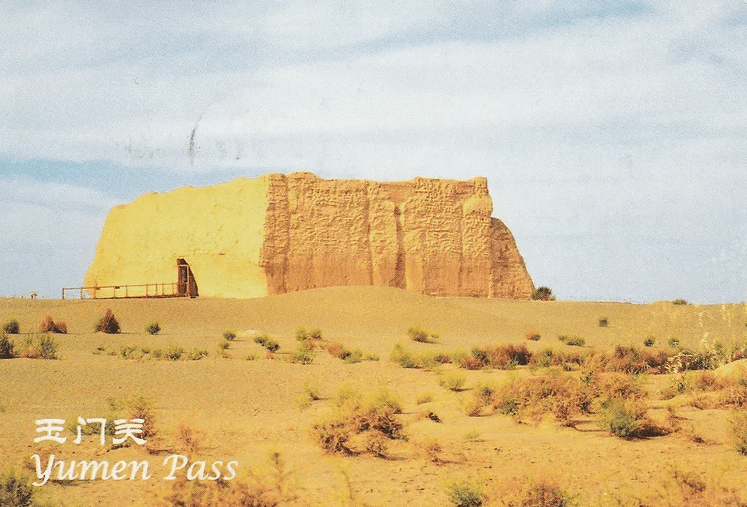
Received through a private swap on 09.10.2017
Yumen pass or Jade Gate or Pass of the Jade Gate is a pass of the Great Wall where the silk road passed in the 202 BC to 220 AD.
 Unesco Postcards