Unesco description
Between the 17th and 20th centuries, the ruling dukes of Liechtenstein transformed their domains in southern Moravia into a striking landscape. It married Baroque architecture (mainly the work of Johann Bernhard Fischer von Erlach) and the classical and neo-Gothic style of the castles of Lednice and Valtice with countryside fashioned according to English romantic principles of landscape architecture. At 200 km2 , it is one of the largest artificial landscapes in Europe.
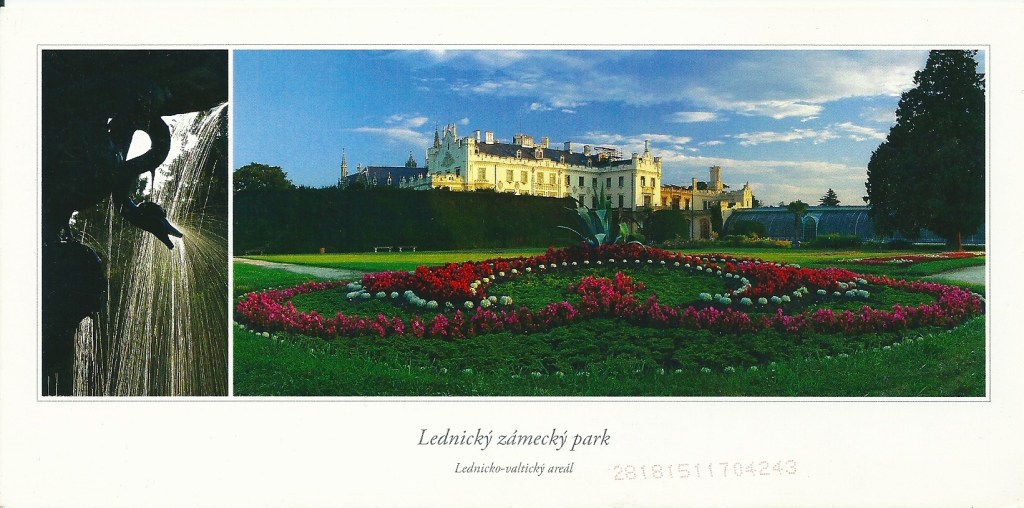
Received through Postcrossing on 13.11.2010
History:
Since Lednice/Eisgrub first passed into the hands of the House of Liechtenstein in the mid-13th century, its fortunes had been tied inseparably to those of that noble family. The palace of Lednice began its life as a Renaissance villa; in the 17th century it became a summer residence of the ruling Princes of Liechtenstein. The estate house — designed and furbished by baroque architects Johann Bernhard Fischer von Erlach, Domenico Martinelli, and Anton Johan Ospel — proclaimed rural luxury on the grandest scale. In 1846-58 it was extensively rebuilt in a Neo-Gothic style under the supervision of Georg Wingelmüller.
The surrounding park is laid out in an English garden style and contains a range of Romantic follies by Joseph Hardtmuth, including the artificial ruins of a medieval castle on the bank of the Thaya/Dyje River (1801) and a solitary sixty-metre minaret, reputedly the tallest outside the Muslim world at the time of its construction (1797–1804).

Received through a private swap on 04.12.2013
History:
The town of Valtice contains one of the most impressive Baroque residences of Central Europe.
 Unesco Postcards