Unesco description
In south-west Alberta, the remains of marked trails and an aboriginal camp, and a tumulus where vast quantities of buffalo (American Bison) skeletons can still be found, are evidence of a custom practised by aboriginal peoples of the North American plains for nearly 6,000 years. Using their excellent knowledge of the topography and of buffalo behaviour, they killed their prey by chasing them over a precipice; the carcasses were later carved up in the camp below.
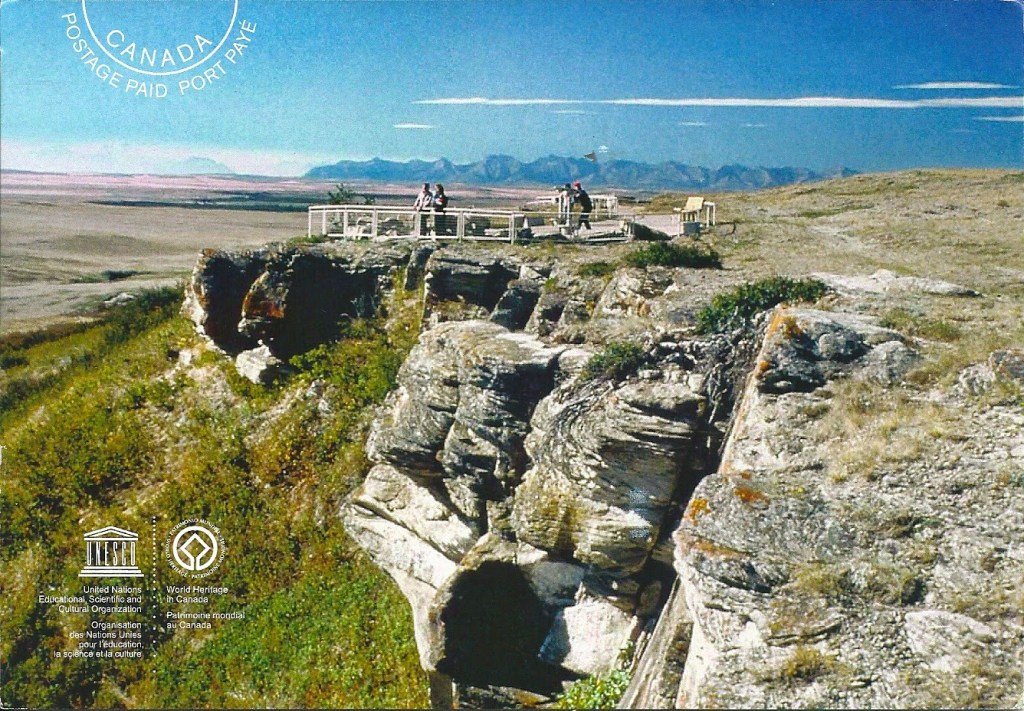
Received through Postcrossing on 21.07.2012
In south-west Alberta, the remains of marked trails and an aboriginal camp, and a tumulus where vast quantities of buffalo (American Bison) skeletons can still be found, are evidence of a custom practised by aboriginal peoples of the North American plains for nearly 6,000 years. Using their excellent knowledge of the topography and of buffalo behaviour, they killed their prey by chasing them over a precipice; the carcasses were later carved up in the camp below.
In Blackfoot, the name for the site is Estipah-skikikini-kots. According to legend, a young Blackfoot wanted to watch the buffalo plunge off the cliff from below, but was buried underneath the falling buffalo. He was later found dead under the pile of carcasses, where he had his head smashed in.
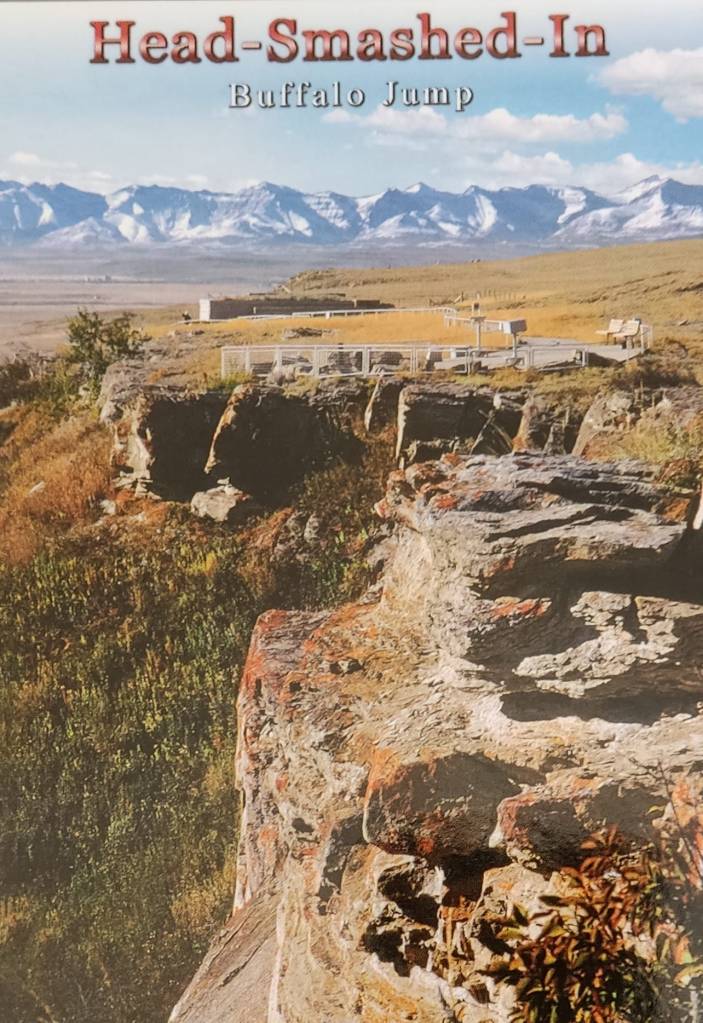
Received from Theresa L. on 01.01.2018
The buffalo jump was used for 5,500 years by the indigenous peoples of the plains to kill buffalo by driving them off the 11 metre (36 foot) high cliff. Before the late introduction of horses, the Blackfoot drove the buffalo from a grazing area in the Porcupine Hills about 3 kilometres (1.9 mi) west of the site to the “drive lanes”, lined by hundreds of cairns, by dressing up as coyotes and wolves. These specialized “buffalo runners” were young men trained in animal behavior to guide the buffalo into the drive lanes. Then, at full gallop, the buffalo would fall from the weight of the herd pressing behind them, breaking their legs and rendering them immobile. The cliff itself is about 300 metres (1000 feet) long, and at its highest point drops 10 metres into the valley below. The site was in use at least 6,000 years ago, and the bone deposits are 12 metres (39 feet) deep. After falling off the cliff, the buffalo carcasses were processed at a nearby camp. The camp at the foot of the cliffs provided the people with everything they needed to process a buffalo carcass, including fresh water. The majority of the buffalo carcass was used for a variety of purposes, from tools made from the bone, to the hide used to make dwellings and clothing. The importance of the site goes beyond just providing food and supplies. After a successful hunt, the wealth of food allowed the people to enjoy leisure time and pursue artistic and spiritual interests. This increased the cultural complexity of the society.
Head-Smashed-In was abandoned in the 19th century after European contact. The site was first recorded by Europeans in the 1880s, and first excavated by the American Museum of Natural History in 1938. It was designated a National Historic Site of Canada in 1968, a Provincial Historic Site in 1979, and a World Heritage Site in 1981.
 Unesco Postcards