Unesco description
The Greater Blue Mountains Area consists of 1.03 million ha of sandstone plateaux, escarpments and gorges dominated by temperate eucalypt forest. The site, comprised of eight protected areas, is noted for its representation of the evolutionary adaptation and diversification of the eucalypts in post-Gondwana isolation on the Australian continent. Ninety-one eucalypt taxa occur within the Greater Blue Mountains Area which is also outstanding for its exceptional expression of the structural and ecological diversity of the eucalypts associated with its wide range of habitats. The site provides significant representation of Australia’s biodiversity with ten percent of the vascular flora as well as significant numbers of rare or threatened species, including endemic and evolutionary relict species, such as the Wollemi pine, which have persisted in highly-restricted microsites.
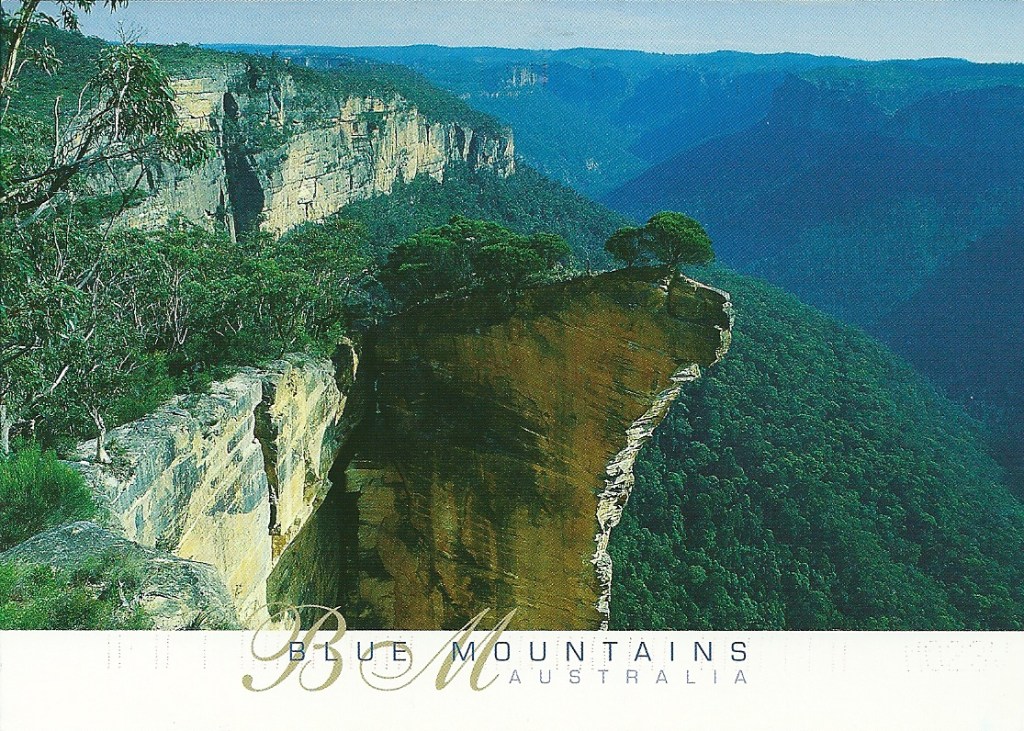
Received through Postcrossing on 22.02.2012
The area is called the Blue Mountains because when the temperature rises, the essential oil of Eucalyptus trees evaporates and disperses into the air. When the sunlight touches it, it seems blue to human eyes.
Despite the name ¨mountains¨ the area is actually an uplifted plateau with the highest point being Mount Werong (1.215 meters).
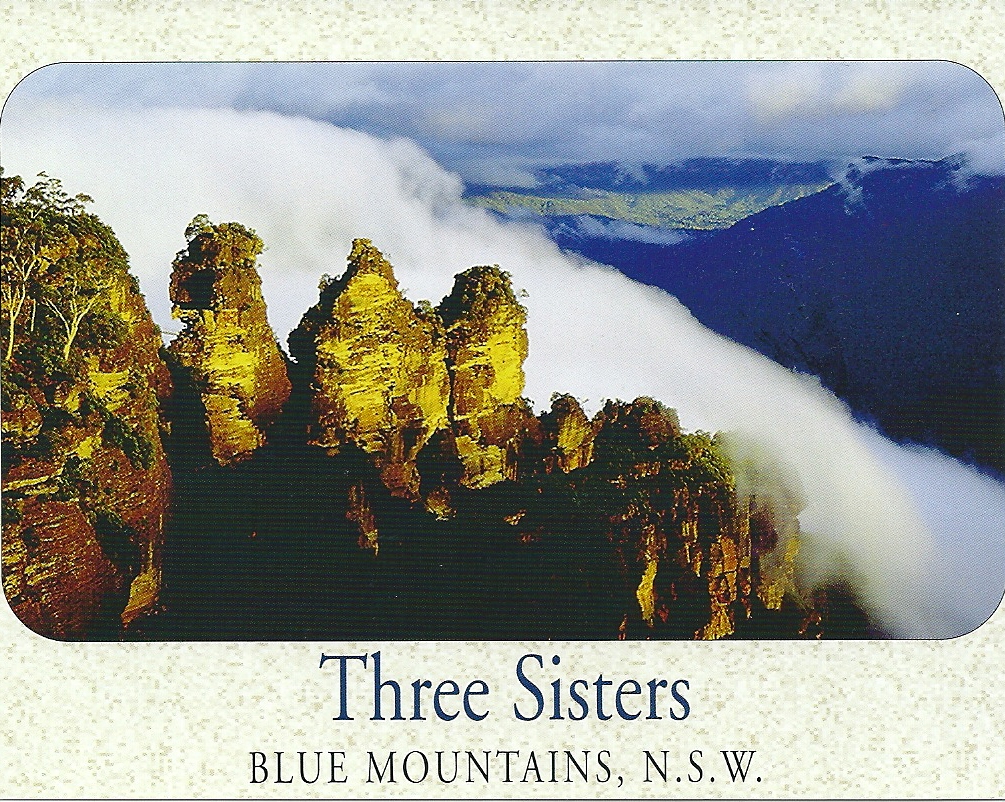
Received through a private swap on 10.03.2014
The Three Sisters is a rock formation close to the town of Katoomba and one of the Blue Mountains most well-known sites. Their names are Meehni (922 m.), Wimlah (918 m.) and Gunnedoo (906 m.). Leyend says that the three sisters lived in the valley as members of the Katoomba tribe. They fell in love with three men from a neighbouring tribe but marriage was forbidden. The brothers were not happy to accept this and decided to capture the sisters. A battle followed and the sisters were turned to stone by an elder to protect them but he was killed in the fighting and no one could turn them back.
 Unesco Postcards